Middle-aged and struggling to read the small print?
Wish you could read without reaching for your reading glasses? Depending on your eyes, vision needs and surgical suitability, a refractive lens exchange may be an option to explore. Or the LASIK-based reading glasses treatment PRESBYOND®.
Once you’re over 45, you may start to notice your eyes are less able to zoom from far to near, and reading gets harder and harder. This normal part of the ageing process is called presbyopia. Reading glasses, bifocals or multifocal glasses are a simple solution. But for some people, they can be frustrating.
We don’t want to get too technical about it. But if you’re considering eye surgery to help your age-related near vision problems, it’s always good to know what’s going on.
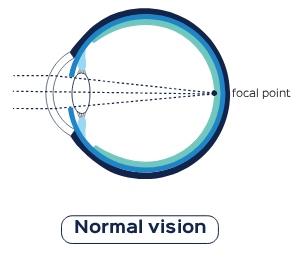
In a younger person, the muscles and lenses are flexible, allowing the eyes to easily change focus between objects up close, in the middle distance and far away.
In older patients, the eye’s muscles and lenses lose their natural elasticity, making it harder to change focus and see close up.
ASSESSMENT & DISCUSSION
Fed up with fumbling for your reading glasses or tilting your head to find the right angle in your multifocals? A comprehensive assessment helps us determine whether presbyopia treatment may be suitable for you.
We’ll assess your eye health and vision, and discuss the lifestyle activities that matter most to you. If we find that you may be suitable for treatment, we’ll explain your options and what to expect during the procedure and after surgery, including recovery considerations. And we’ll answer all your questions along the way.
There’s no pressure to book surgery if you find out that you’re suitable. But you’ll have all the insights you need to make an informed decision, and, of course, our guidance should you decide to take the next step.
TREATMENT
As presbyopia progresses, most people reluctantly resort to wearing reading glasses, multifocal glasses or multifocal contact lenses. But relying on visual aids has its drawbacks – misplacing them, replacing them and cleaning them, not to mention the constant on and off.
At ELS, there are two main surgical approaches commonly considered for presbyopia. Depending on your suitability, we can replace your eye’s ageing lens with an IOL in a refractive lens exchange. Or, we can perform PRESBYOND® laser vision correction.
Click on a treatment to see how it works.
Some presbyopia treatments use monovision, where one eye is treated to support vision for near tasks and the other for distance. While this approach works well for some people, others may notice reduced clarity at intermediate distances, such as computer work.
PRESBYOND is a laser-based approach that aims to extend the range of focus in both eyes by carefully planning how near, intermediate and distance vision are balanced. For suitable patients, this may support a more continuous visual range, including intermediate distances.
A monovision treatment aims to make one of your eyes better for distance vision and the other better for close-up. This can create a noticeable blur in the intermediate (middle) distance – a visual experience which may be hard for some patients to tolerate.
Some patients experience changes in depth perception, contrast sensitivity or intermediate vision with monovision, which can take time to adapt to or may not suit everyone.
A PRESBYOND treatment aims to create a wider range of focus in both eyes with a blend zone in the intermediate distance. This helps to create a smoother visual experience as you change focus from near to far.
Potential advantages for suitable patients may include improved continuity of vision across near, intermediate and distance ranges, retained binocular vision for many daily tasks, and reduced reliance on reading glasses for some activities.

We know you have choices when it comes to exploring vision correction surgery. And we want you to feel confident that we’re the clinical team you can trust. Learning more about our team and approach can help you decide whether ELS is the right fit for you.
The information on this page is general in nature, and you should consult your ophthalmologist for specific medical advice.