Struggling with short-sightedness? Melbourne’s Eye Laser Specialists may be able to help
Tired of blurred distance vision? When you rely on glasses or contact lenses for short sightedness, it means always having a backup plan. With the right treatment, many patients may no longer need one.
Let’s look at shortsightedness and your myopia treatment options
OVERVIEW
What is short-sightedness?
Short-sightedness (myopia or near-sightedness) is the world’s most common eye condition. If you can see close-up objects clearly, but distant objects look blurred, you’ll be familiar with how limiting it can feel.
Glasses or contacts can help, but for some people, having to rely on them is an inconvenience.Whether it’s for beach days, exercise or everyday life, reducing reliance on glasses or contact lenses can make everyday activities feel easier.
A LITTLE BIT OF EYE ANATOMY
What causes shortsightedness?
We don’t want to bog you down with details. But when you’re considering a surgical procedure, it’s always good to know what’s going on.
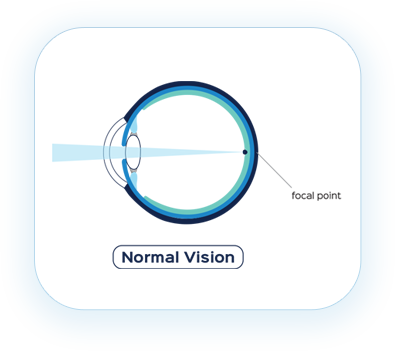
In a perfect eye, light rays enter your eye and focus on a point in the middle of the retina to give you clear, sharp vision.
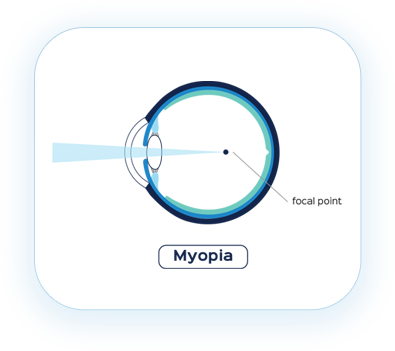
In a short-sighted eye, the eyeball is longer or the cornea steeper than usual. Light rays focus in front of the retina. This is why images in the distance look blurred.
ASSESSMENT & DISCUSSION
How do we diagnose short-sightedness?
Fed up with fumbling for your glasses or fiddling with your contacts? A comprehensive assessment helps us understand whether vision correction may be suitable for you.
Once we assess your vision, eye health and goals, we’llbe able to advise whether treatment may be suitable for vision correction treatment. We’ll explain your treatment options, what to expect during and after the procedure, and we’ll take the time to answer all your questions.
If we find that you’re suitable, there’s no pressure to book surgery. And if laser eye treatment isn’t right for you, we’ll look at alternative treatment plans that could be options to explore.
Improving your distance vision with laser treatment
During your vision correction surgery, our experienced eye surgeons will maketiny corrections that make your cornea flatter. Thisreshapes your cornea to help reduce your myopia by enabling light rays to focus more accuratelyon the retina. And, where appropriate, we can often treat any astigmatism at the same time.
The procedure is short, and many people are back to their usual routine within days, depending on the treatment type and individual healing process.
We’ll schedule several follow-up appointments to monitor your recovery and visual progress.
Disclaimer: It’s important to note that not everyone is suitable for vision correction treatment, and every patient’s journey is a little bit different. Healing responses are unique, and results and benefits may vary. In some laser eye surgery cases, over- and under-correction may occur, and a top-up laser procedure called an ‘enhancement’ may be required. As with any surgery, there are potential side effects and risks, of which you’ll be fully informed before any decisions are made.
Looking for clear advice on your vision correction options?
We’re here to help.
Not everyone is suitable for vision correction surgery. Your suitability, experience and results will depend on your eyes, your health, and how you heal. All medical and surgical procedures carry potential risks and side effects, and we’ll discuss these before any decisions are made. The information on this page is general in nature, and you should consult your ophthalmologist for specific medical advice.